Dental Implants for Seniors
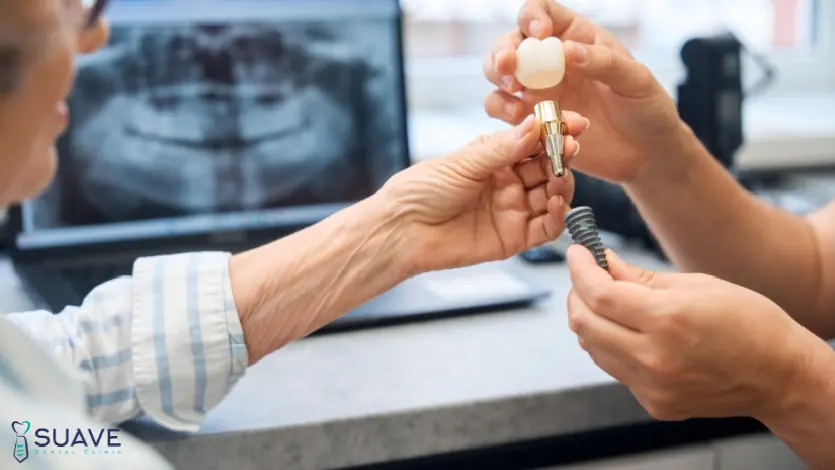
Table of Contents
Aging is a natural biological process that happens to all of us. With getting old, there are some age-related health problems that affect oral and dental health. Losing teeth and jawbone resorption are some of them.
Replacing missing teeth with dental implants for seniors may be challenging. Here’s how our specialised dentists deal with it.
When is dental implant treatment indicated for seniors?
Seniors often face various dental issues that make them in a high need for the teeth replacement options, especially dental implants. Implants are ideal for older adults not only for replacing missing teeth with a fixed, permanent solution, but also for a good quality of life.
- Single tooth loss: a single dental implant is the best tooth replacement option. When only one tooth loss is adjacent to healthy natural teeth, it’s better to replace it with a single dental implant rather than other conventional bridges (which require grinding of the adjacent healthy tooth).
- Loss of abutment teeth that support a denture: When the critical anchor tooth is lost, a single dental implant can take its place, allowing you to adapt your existing denture rather than remaking it entirely.
- Complete tooth loss: For edentulous patients who need complete arch replacement, dental implants offer a superior solution; in the lower jaw, 2 dental implants often support a complete lower implant-supported overdenture, while the upper jaw typically uses all-on-4 dental implants for maximum stability.
- Long-span tooth loss: Dental implants can be used to stabilize a partial denture and prevent neighbouring teeth from drifting.
- Limitations of removable prostheses: Removable dentures, especially for patients who suffer some difficulties in manual handling (such as arthritis or disabilities), are difficult and exhausting, so a more stable and fixed option like an implant-supported denture is preferable.
- Bone preservation: It maintains bone density and volume by evenly distributing bite forces within the bone and periodontium, which in turn affects the patient’s natural facial structures and contours, and slows down the process of jawbone resorption.
You may be surprised by the profound effect of getting dental implants on your overall health. A study published in the Journal of Dental Research found that patients with dental implants consume more protein and fiber compared to those with conventional dentures. This means you can comfortably eat beans, meat and chew much more food than with denture, which improve bowl movement, enhance immunity, and upgrade the quality of life.

Denture vs Implant: which is right for replacing a full arch?
When are dental implants not suitable for seniors?
Although dental implants are available in different shapes, sizes, and designs to fit different cases, there are still specific conditions where dental implants may not be suitable for seniors.
- Bone-Altering Medications: Patients actively taking blood thinners, immunosuppressants, or intravenous bisphosphonates (often prescribed for osteoporosis), which lower bone density, require specialized medical clearance due to the risk of impaired bone healing.
- Compromised periodontal disease: Severe periodontitis and gum disease negatively affect the gingival and bony tissue, increasing the risk of bone loss, implantitis, and significantly decreasing the success rate of dental implants.
- Severe dry mouth “xerostomia”: Normal saliva flow has a vital role in washing away bacteria and decreasing tissue irritation. So, lack of saliva increases the risk of tissue irritation and infection around the dental implants.
- Unstable medical condition: Systemic medical issues that negatively affect healing and osseointegration, such as
- Uncontrolled diabetes
- Cardiovascular disease
- Active cancer treatment
- Osteoporosis
- Autoimmune disease
- Severe malnutrition
- Physical or cognitive limitations: Patients with Alzheimer’s or dementia are unable to maintain routine, proper daily oral hygiene independently without needing any help.
- Heavy smokers, as smoking has a direct effect on blood circulation, so it affects the healing and the osteointegration ability of the tissue.

Discover Same-day implants and who is a suitable candidate and who is not.
The Best Dental Implants for Seniors: Low Bone Density Solutions
The most common clinical challenge implantologists face when treating older adults is a compromised alveolar bone level (jawbone loss). Fortunately, modern implantology offers several advanced solutions designed specifically for patients with low bone density, allowing them to bypass the need for invasive and costly bone grafting procedures.
Options for Single or Multiple Missing Teeth:
- Narrow Diameter Implants (NDIs): For patients with a narrow bone ridge, implantologists utilize advanced NDIs. Premium brands like Straumann offer the Roxolid® implant (often 3.3mm in diameter), which utilizes a highly durable titanium-zirconia alloy. This provides the strength of a traditional implant while fitting into a much smaller bone footprint.
- Mini Dental Implants (MDIs): Mini implants (typically less than 3.0mm in diameter) are minimally invasive options often used to stabilize lower dentures for patients who lack the bone volume for traditional implants.
- Trabecular Metal Implants: Unlike standard solid titanium, these specialized implants (such as those by Zimmer Biomet) feature a highly porous, 3D tantalum structure. This trabecular design mimics the spongy architecture of natural bone, allowing new bone to grow directly through the implant, rather than just around it. This is highly effective for patients with compromised healing or poor bone quality.
- Short Implants & Locking-Taper Designs: For seniors lacking vertical bone height (especially in the lower jaw near the nerve), specialized short implants (like the Bicon system) utilize a friction-fit, “screwless dental implants” locking taper design to provide immense stability without requiring deep bone penetration.
- Zygomatic Dental Implants: Designed exclusively for patients experiencing severe bone loss in the upper jaw, these specialized, extra-long implants bypass the maxillary bone entirely and anchor securely into the dense cheekbone (zygoma), providing premium stability for full-arch restorations.
Options for Total Tooth Replacement (Edentulous Patients):
- Implant-Supported Overdentures (Snap-on Dentures): A highly cost-effective solution for total tooth loss. By placing just 2 to 4 conventional or mini implants in the jaw, a removable denture can be securely “snapped” into place, eliminating slipping and the need for messy adhesives.
- Hybrid Dentures: This is known as full-mouth reconstruction with dental implants (All-on-4 / All-on-6), in which a protocol strategically places 4 to 6 implants at specific angles within the densest parts of the jawbone. A complete, permanent set of ceramic or zirconia teeth is then permanently affixed to the implants, providing a full-mouth restoration that looks, feels, and functions exactly like natural teeth. See the difference between all-on-4 and all-on-6 dental implants.

Discover the cost of full-mouth dental implants in Turkey!
At Suave Clinic, we offer personalized Treatment Planning; choosing the right implant system requires profound clinical precision. By utilizing advanced 3D CBCT imaging and a comprehensive review of your systemic health, your implantologist will engineer a customized surgical plan designed to maximize your bone utilization and ensure a lifetime of functional stability.
Alternatives to dental implants for older patients
Fortunately, dental implants are not the only option. There are several effective alternatives to dental implants for those who aren’t candidates for surgical procedures, such as:
- Removable denture
- Complete removable dentures: A full set of removable artificial teeth, arranged in a particular way on an acrylic or metal base that rests directly on the ridge, replacing the entire arch and the missing teeth.
- Partial Removable dentures: A partial set of acrylic teeth attached to a metal or acrylic framework, characterised by small clasps that are attached to the neighbouring natural teeth for more stability and retention.
- Fixed dental bridge: A permanent, fixed prosthesis that is used to replace one or multiple missing teeth by preparing and “crowning” the teeth on either side of the gap, which are connected together with artificial teeth “pontics”.
What do dental implants cost for seniors in Turkey?
Because Medicare and standard Western dental insurance rarely cover full-mouth dental implants, many seniors face exorbitant out-of-pocket costs at home. This has made Turkey a premier destination for dental tourism, offering world-class, all-inclusive implant treatments at a fraction of US and UK prices, without compromising on premium materials or international clinical standards.
See the affordable dental implants Suave Clinic offers for our patients!
Estimated Dental Implant Costs at Suave Clinic (Turkey):
- Conventional Single Implant: Starting from $600 (Compared to $3,000+ in the USA).
- Mini Dental Implants (MDIs): Starting from $550 (Compared to $2,300+ in the USA).
- Zygomatic Implants (Complex Bone Loss): Starting from $3,000 (Compared to $20,000+ in the USA).
Cost of full-Mouth dental implants (Dual Arch / Both Jaws):
- All-on-4 Full Mouth: Starting from $2,000.
- All-on-6 Full Mouth: Starting from $2,500.
- All-on-8 Full Mouth: Starting from $3,000.
Without the cost of the final crown restoration, whether it’s ceramic crowns or titanium-reinforced hybrid dentures.

Discover full-mouth dental implants in Turkey. Get your free consultation now and enjoy our packages and offers!
Ultimately, a patient’s age is never the primary deciding factor for dental implants. There is absolutely no upper age limit for achieving a fully restored, confident smile.
Your systemic health, bone density, and medical history are significant factors that indicate whether dental implants are right for seniors. With proper treatment planning, seniors in their 70s, 80s, and beyond routinely enjoy the life-changing benefits of permanent dental implants.
Get A Free Dental Consultation
Get A Personalized Treatment Plan and Quotation
Dental Implants for Elderly Patients
Are dental implants safe for seniors?
Yes, of course, dental implants are completely safe for seniors; in fact, they are often the best and most reliable solution for them. Dental implants have proven successful for decades, with a failure rate of less than 2% in our patients. This is related to minor risks that can be managed and controlled with proper clinical planning and regular maintenance.
Does insurance cover dental implants for seniors?
Unfortunately, there are no free dental implants for seniors on original Medicare insurance. However, seniors enrolled in specific private plans such as Humana Medicare Advantage may receive extra advantages for certain dental services, depending on specific policy details. Because this is typically partial coverage (with a fixed percentage or an annual fixed cost for all dental treatments), patients need to pay more to afford the cost of dental implants in the USA.

References
Medically Reviewed


