Table of Contents
Individuals who have lost all their teeth can restore both the function and aesthetics of their missing teeth through dental implants.
A dental implant is an artificial tooth root on which a ceramic crown is placed, replacing a missing tooth and mimicking the natural emergence of teeth from their roots.
This titanium post fuses with the bone tissue over a few months to provide a stable artificial root on which a dental crown can be installed. The implants stimulate the jawbone, maintaining volume and preventing facial changes associated with bone loss.
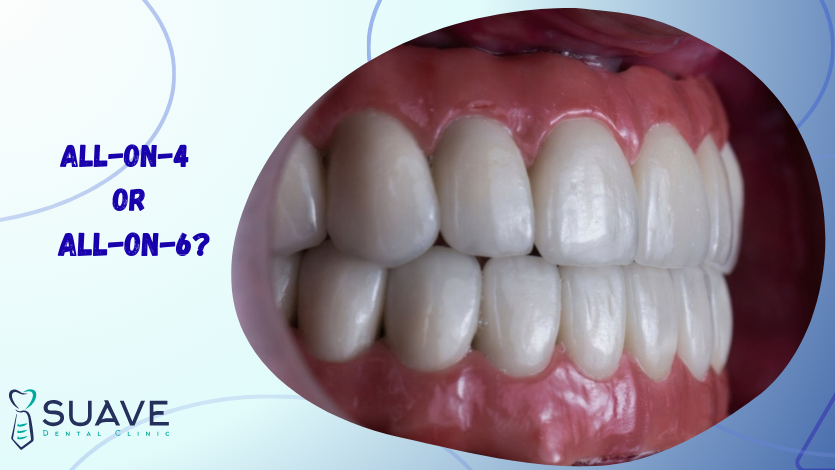
All-On-4 and All-On-6 are types of implant systems that are used to reconstruct a patient’s smile. This technique is an advanced technique for patients who need full mouth rehabilitation and reconstruction with dental implants.
These patients are also recommended for removable dentures as an alternative to dental implants, but statistics show that most of them find that their removable dentures aren’t stable and less efficient.
Thus, using a fixed denture installed on 4 or 6 dental implants directly into the jawbone, making it natural and reliable like natural teeth.

See dentures vs implants, which one is better for you!
All-On-4 Dental Implants
The All-On-4 dental implant option is done for patients who have compromised teeth due to gum problems.
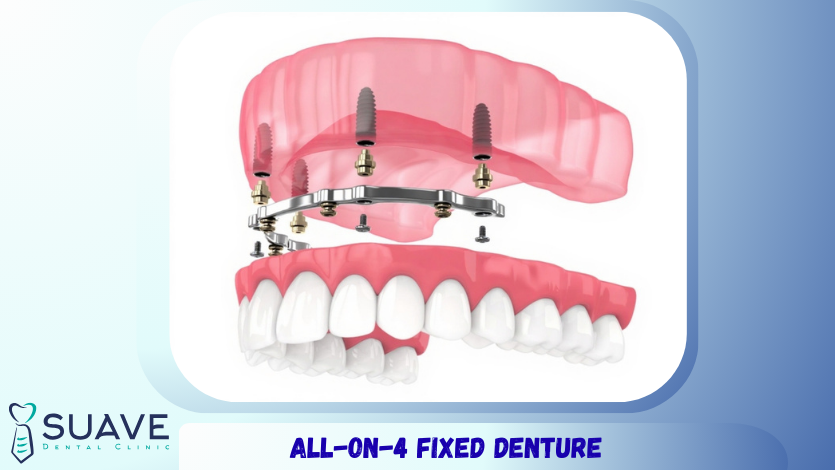
Using computer-guided technology, four dental implants are placed at a 45-degree angle into the jaw for a secure and long-lasting placement.
By this way of placement, complex post-dental surgery, such as grafts, can be avoided, as areas that need bone grafts or sinus lifts are avoided.
The four implants support a fixed prosthesis containing 10-14 teeth. This prosthesis cannot be removed unless your dentist uses their tools to remove it during annual check-ups.
By proper maintenance and oral hygiene measures, the all-on-4 can last for up to 15-20 years.
Pros and Cons for All-on-4 dental implants
Pros:
- Fewer implants: Less surgical complications, and minimally invasive.
- Affordable: Lower cost compared to All-on-6.
- Faster treatment
- Great for patients with bone loss: The idea is that the angled implants make it possible even if you have less bone.
- Good stability for elderly patients with moderate to severe bone resorption.
Cons:
- Not a good option for those who have a heavy and deep bite.
- More stress per implant: Each implant carries more bite pressure.
- If one implant fails, the entire arch can be affected.
Who is a Better Candidate for All-on-4 Implants?
- Patients with severe bone loss who cannot withstand six implants.
- People are looking for a budget-friendly option to restore their missing teeth.
- Those who want faster results.
All-On-6 Dental Implants
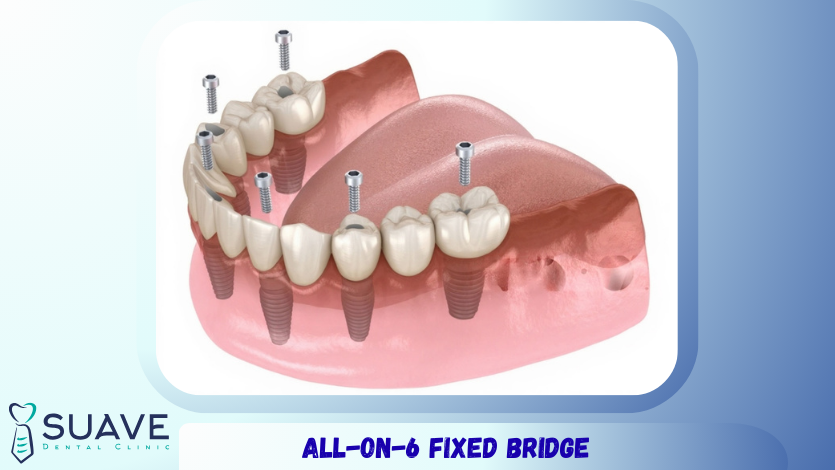
Patients with sufficient bone structure to sustain six implants to hold a complete set of teeth are the ideal candidates for the pioneering All-on-6 implant procedure.
All-on-6 implants have a 20+ year survival or beyond with proper dental hygiene and routine examinations.
Pros and Cons for All-on-6 dental implants
Pros:
- Superior support and functionality: Excellent for chewing hard foods
- Lower risk of failure: The remaining implants can still securely hold the teeth in place even if one fails.
- Superior stability: The comfort and fit are more like those of real teeth.
- Helps prevent bone loss: By uniformly distributing the pressure between six implants, bone loss is minimized.
Cons:
- More expensive than All-on-4.
- More complicated and invasive surgery: The procedure takes a longer time and requires a longer recovery time.
- Not suitable for everyone as it needs higher bone density and volume.
Who is a Better Candidate for All-on-6 Implants?
- Patients with enough bone to support six implants, with suitable bone volume and density.
- Heavy chewers.
- Patients who want the longest-lasting and most stable solution.
Which Is Better, All-on-4 or All-on-6 Dental Implants?
The answer isn’t that one is “better” than the other; it’s about which one is better for you.
Everyone is different. Some people have strong jawbones. Others have weak or thin bones.
At Suave Clinic, our dentists check your mouth and jawbone density by taking X-rays or 3D scans, with a thorough diagnosis and medical history assessment to make you a customized treatment plan.
Stability and Strength
All-on-6 implants system creates more stability and support for the installed restoration; this system helps distribute forces and pressure evenly, similar to the roots of natural teeth. For patients who want the most secure, robust solution, All-on-6 is a more suitable option than All-on-4.
Look and Feel
Both All-on-4 and All-on-6 systems are transformative choices and life-changing dental treatments that restore perfect teeth with an ideal smile.
You will receive a custom-milled, fixed denture or bridge that looks, feels, and functions like natural teeth. You can eat, speak, and smile with total confidence.
The Procedure
The All-on-4 procedure is simpler, less invasive, and quicker. Although the all-on-6 dental implants procedure involves the same steps, it requires the precise placement of two additional implants, making the surgery slightly longer. Both, however, are typically completed in a single day, and patients often leave with a temporary fixed bridge.
Long-Term Bone Health
All-on-6 Dental implants work by stimulating the jawbone, just like natural tooth roots. This stimulation is what stops the bone loss that always occurs after teeth are lost. The even distribution of chewing forces increases stimulation over a wider area, preventing bone atrophy and resorption in the long term. However, All-on-4 is more suitable for patients with severe bone loss and lower density.
Cost
Fewer implants mean a lower cost. All-on-4 is an excellent solution that provides incredible value with affordable prices. You can get your full mouth dental implants with cost-effective, all-inclusive packages and deals at Suave Clinic for affordable dental implants with high-end brands.
In Suave Dental Clinic, we offer international patients personalized treatment under the hands of implant specialists for the best quality results.
Secure and Safe
Both procedures are extremely safe and not painful when performed by an experienced surgeon or prosthodontist, and with the use of effective local anesthesia. At Suave Clinic, we use a digital workflow that combines 3D CBCT scanning and surgical guides to plan every implant placement with millimeter precision, ensuring a safe, predictable, and successful outcome.
Which Type of Dental Implant Has the Highest Success Rate?
Both All-on-4 and All-on-6 have exceptionally high success rates, studies’ results show between 95-99% over 10 years when performed by a skilled surgeon like our skilled team at Suave Clinic.
We care to provide our patients with the best experience without compromising on quality. Our surgeons and prosthodontists use high-quality materials with the best implant brands like Straumann®, Nobel Biocare™, Osstem, and Dentsply Sirona.
The key to success isn’t the number of implants, but the quality of the planning, the skill of the surgeon, and the patient’s post-operative care.
Get A Free Dental Consultation
Get A Personalized Treatment Plan and Quotation
Which Type of Dental Implant Lasts Longer?
The implants themselves (the titanium posts) are designed to be permanent and can last a lifetime. The prosthesis (bridge or denture) will experience wear and tear, just like natural teeth. A high-quality acrylic bridge may last 10+ years, while a premium zirconia bridge can last 20 years or more.
All-on-6 may offer a slight edge in longevity for the prosthesis because the bite forces are better distributed, causing less wear on the bridge.
Dentures, Bridges, and 3-on-6 Implants Restorations
The prosthetics used for all-on-4 and all-on-6 are not traditional, removable dentures. They are permanent, fixed dentures or bridges that are screwed to the implants and can only be removed by the dentist.
- Prosthesis on All-on-4: A single, full-arch bridge made of high-grade acrylic (often reinforced with a titanium bar) or zirconia, this is called a hybrid denture or a fixed denture.
- Prosthesis on All-on-6: A full-arch bridge, also made of acrylic or zirconia. The six-implant foundation provides more strength to withstand more premium materials like full zirconia.
- 3-on-6 Dental Implants: This is a different, more advanced technique. Instead of one solid bridge, the dentist places three separate bridges onto the six implants.
This segmented approach is excellent for oral hygiene and can feel even more natural, as it mimics the natural separation of teeth.
Both systems can be used to create a stunning, perfectly natural smile. The “fake gum” (pink gingiva) is a part of the acrylic base and also the zirconia restoration, which is skillfully crafted to cover any bone discrepancies and provide a seamless, healthy look.
Cost of Dental Implant Systems
Our cost of full mouth dental implants is generally much lower than the same procedure in the US and Europe, with no wasting time in waiting lines, or extra fees, you get savings of up to 60%!
- All-on-4 implants cost:
$3,000–$10,000 in Turkey
$24,000–$30,000 in the US
- All-on-6 dental implants cost:
$5,000–$15,000 in Turkey
$28,000–$36,000 in the US.
- 3-on-6 dental implants cost:
This is the most premium option, due to the ceramic/zirconia dental bridges installed on the implants, which is why the cost is higher, depending on the materials used.
In Suave Dental Clinic, we offer international patients personalized treatment under the hands of implant specialists for the best quality results.
Book your full mouth dental implants package with Suave Clinic
At Suave Clinic in Turkey, we help patients from all over the world understand these options in simple words, so you know exactly what fits your smile, your budget, and your long-term goals with guidance from our expert dentists.
You can book your dental implants consultation today and take the first step toward a confident, natural-looking smile.
All-on-4 or All-on-6 FAQs
Who Is Not a Better Candidate For Full Mouth Dental Implants?
Like any surgery, the placement of All-on-4/6 implants involves certain risks, which is why the ideal candidate must be in a general state of good health.
Patients with serious systemic conditions, such as uncontrolled diabetes, autoimmune diseases, tumors, or severe cardiovascular conditions, may be at higher risk of postoperative complications and implant osseointegration failure.
Patients who suffer from severe gingival inflammation and periodontitis, or problems with the temporomandibular joint.
Heavy smokers are also more at risk of implant rejection due to tobacco’s negative influence on bone and soft tissue healing.
Can I eat steak with All-on-Four implants?
Yes, once your implants have healed and the fixed crowns are installed in place, you can eat whatever you want, like chewing steak, crunchy, firm food, nuts, etc. Keeping in mind that all-on-6 provides a much stronger bite and more denture support for chewing.
What is the biggest reason implants fail?
The biggest reasons are uncontrolled systemic disease, like uncontrolled diabetes, heavy smokers, patients with bad oral hygiene, and non-skilled, non-professional surgeons.
Can I chew gum with All-on-4 implants?
Yes, unlike removable dentures, where chewing gum is impossible, fixed dentures on All-on-4 implants are stable, well-retained, and can’t be dislodged easily by eating sticky food or chewing gum.
Are all-on-6 dental implants worth it?
All our patients have said yes. This is considered a good investment, providing a solid, permanent, cost-effective solution that feels completely natural and can last a lifetime.
Do all-on-6 implants have fake gums?
Yes, fixed prostheses that are installed on all-on-4 or all-on-6 dental implants have a pink base, as in a fixed denture, teeth are attached to a pink acrylic base, and in the case of ceramic and zirconia bridges, dental lab technicians can add pink zirconia or porcelain mimicking the gum appearance as an effective solution to restore lost gums that followed bone resorption.
How long do you go without teeth when getting implants?
At Suave Clinic, you won’t go without teeth for a single day. On the day of implant surgery, temporary bridges or a removable denture are placed till the bone healing is completed after 3-6 months.
How many teeth are on all-on-6?
The denture, or bridge, that attaches to the implants contains 12 to 14 teeth per arch, restoring your smile and function.

References
Medically Reviewe