Table of Contents
While many people of different ages are suffering from tooth discolorations and stains due to various factors, many are seeking quick, easy fixes for a brighter smile. As bright teeth became a global trend, many teeth whitening options do not require a visit to a dentist. One of these options is teeth whitening strips
What are whitening strips?
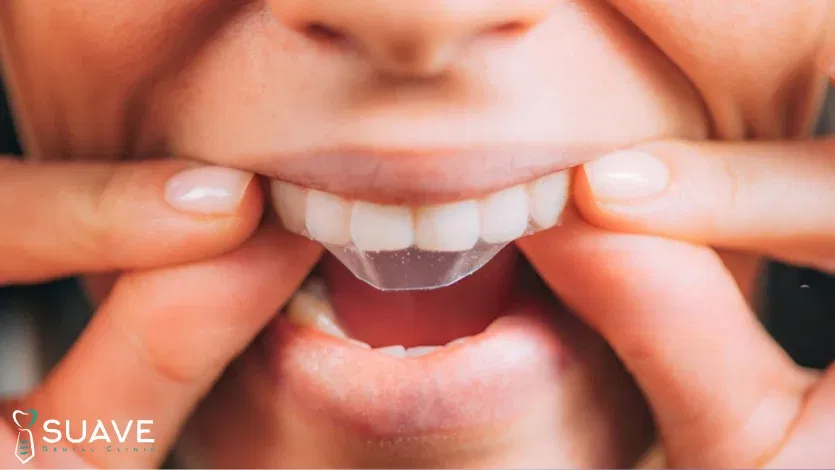
It’s an OTC home whitening system that can be purchased without a prescription, from pharmacies or online shops. It comes in the form of a clear strip, coated with a bleaching agent at a specific concentration (10-20% carbamide peroxide), applied directly to the tooth surface to produce a whiter effect in a few minutes.
How do teeth whitening strips work?
Home whitening products contain a bleaching agent, either carbamide peroxide or hydrogen peroxide, at a lower concentration than in-office teeth bleaching.
Peroxide material penetrates the tooth’s outer surface (enamel), goes deeper into the second layer of the tooth that contains stains, and begins to dissolve them, making teeth whiter.
It’s not a permanent result. Which means you need a touch-up treatment. Its effect can last for 4 to 6 months. The result might fade within less than 4 months if patients consume more staining foods and drinks, like coffee, wine, cola, berries, and so on.
Book a free consultation and get a quote for teeth whitening service at Suave Clinic.
In-office teeth whitening vs.Whitestrips
In-office teeth whitening results are much stronger than whitening strips; the dental treatment prognosis is bleaching and removal of deep stains in the deep teeth layers, achieving the enamel shade symmetry and harmony, faster and stronger, brighter, whiter teeth in the same appointment.
We can’t alter teeth whitening dental treatment with whitening strips, as they are for limited use:
- You can’t get instant whiter teeth after multiple uses of whitestrips; you must at least wait for 2 weeks.
- Deep brown, dark stains can’t be bleached by only whitening strips; it also may depend on the brand’s efficacy.
- Teeth bleaching strips are not always without a dentist’s visit, as for better results, you must get professional dental cleaning and polishing to eliminate plaque, calculus, and superficial stains before the strips application.
- The result of teeth whitening strips depends on the patient’s compliance with the brand’s instructions, the application times, and also adhering to good oral hygiene.
- Laser teeth whitening can brighten teeth by 5 to 10 shades, with an average improvement of 7-8 shades in a single session, while whitening strips have maximum efficacy in brightening teeth by 2 shades only.
That’s why chemical and laser teeth whitening at the dentist’s is a professional dental treatment with instant guaranteed whiter results that meet your expectations.

Want to know why your teeth are yellow when you brush them every day?!
Get a Free consultation with our experts, and book the dental package that suits your needs.
Best teeth whitening strips
Knowing the best whitening strips is a public demand. It’s better to ask your dentist for advice, as whitening strip products are different in efficacy according to the severity of the teeth stains and discolorations.
Noting that the whitening strips’ effect doesn’t resolve deep dark stains, when compared to the result of in-office teeth whitening.
However, if you have healthy teeth and gums combined with good general health, you can choose one of the following products:
- Crest teeth whitening strips
It’s the most popular one. Come in different types to suit all cases. Types for normal teeth and another for sensitive ones. It’s characterised by its significant result, high ability to remove internal and external stains, and lasting impact (6 months or more). - Lumineux teeth whitening strips
It’s a chemical-free product, containing natural ingredients like lemon peel oil, coconut oil, and sea salt. So, it’s safe to use for a long time until reaching the optimal results. Also, it’s one of the best teeth whitening strips for sensitive teeth. - Oral‑B 3D White Whitestrips
Another common product that aims to whiten teeth with fewer side effects. It’s applied for 60 minutes daily for 2 weeks to get a noticeable result that lasts for a year. - Purple teeth whitening strips
It’s a free peroxide agent product that makes it safer for the teeth’s surface. It works in different ways by neutralising the yellow colour of teeth. - Spotlight Oral Care Whitening Strips
It’s a product made by a dentist. Offering an amazing whitening experience at home. They care to add useful ingredients alongside bleaching agents like hydroxyapatite to protect your tooth surface more during the process. It’s also suitable for sensitive teeth. - Philips Whitening pens
The best teeth whitening pen on the market is the Philips Zoom Whitening Pen. Instead of whitening strips, a low-concentration hydrogen peroxide gel is squeezed outside the pen on the tooth surface and then washed away according to the product’s manufacturer.
How do you use whitening strips for better results?
To get a better result, you should stick to the manufacturer’s instructions, which are changeable from one brand to another. However, there are some common broad lines among them. Including the time of application, the number of uses, and instructions before the application.
How long to leave whitening strips on?
Usually, whitening strips of different brands are left on the tooth surface for 30 to 60 minutes, not more than 30 minutes in each use.
Should you brush your teeth before whitening strips?
It’s better to brush your teeth to remove any plaque or food particles, leaving the tooth surfaces clean. This helps tooth whitening strips adhere well and achieve optimal results.
However, it’s advisable to wait after dental cleaning for 30 minutes before applying whitening strips to avoid gum irritation.
How often should I use whitening strips?
The number of uses to get the effect is different between brands. But it’s most commonly used once or twice daily for about 1 or 2 weeks.
Do teeth whitening strips damage teeth?
According to scientific evidence, teeth whitening strips don’t cause any tooth damage as long as you select a suitable type for your case with ADA approval and follow the instructions to the letter. Following this advice, you can avoid any possible side effects.
Top tips for a whiter smile from Suave Clinic
Fortunately, there are some tips that, if followed, will give you a whiter smile. Here are the tips:
- Maintain good oral hygiene habits that prevent any plaque or bacteria accumulation, which easily picks up stains from food and drinks. Through these steps:
- Brush your teeth twice daily, especially before sleeping.
- Flossing after meals is also important.
- Use antiseptic mouthwash if needed.
- Don’t forget to change your toothbrush after a cold or every 3 months.
- Take care of your diet. Colored food is the main culprit of tooth staining.
- You should avoid any coloured food or drinks. Such as berries, tomato sauce, sports drinks, red wine, coffee, and tea.
- Reduce sugar food intake.
- Eat plenty of food that is rich in calcium, which makes teeth stronger.
- Adhere to healthy eating habits.
- Focus on eating crunchy fruits and vegetables that can clean teeth naturally.
- If you can’t stop consuming coloured drinks, you can drink with a straw to reduce their direct harmful effects.
- Rinse or brush after eating coloured food.
- Stop consuming nicotine products such as cigarettes, vapes, or chewing tobacco, as nicotine causes yellowish stains and brown teeth with time.
- Using a whitening product with ADA approval as a touch-up treatment, like whitening toothpaste, once a week.
- Regular dental visits every 6 months for professional cleaning to remove any plaque or tartar from the teeth’s surface.
- Avoid using scrubbing materials, even natural ones, such as DIY teeth whitening with lemon juice and sodium carbonate; it can damage your teeth’s surface and worsen the case.
Despite whitening strips being OTC products. It’s advisable to ask your dentist first for advice. Depending on your type and level of stains, dentists can decide the best treatment option for you that’s going to be effective.
Get A Free Dental Consultation
Get A Personalized Treatment Plan and Quotation
Teeth Whitening Strips FAQs
Can you use whitening strips with braces?
No, it’s not recommended to use whitening strips with braces. As braces cover part of the tooth, preventing the bleaching agent from reaching those areas, it results in uneven whitening of the same tooth, and a waste of the whitestrips.
Are teeth whitening strips alternatives to teeth whitening?
No, though they are considered one of the whitening systems in the market. But it can’t be considered a direct alternative to teeth whitening. As it doesn’t offer the same result.
Do whitening strips cause gum inflammation?
Yes, but gum inflammation is a common temporary side effect that may happen when the whitening product contacts the gum instead of the tooth surfaces.
Do over-the-counter teeth strips really work?
Yes, it has a noticeable effect on stained teeth. However, its effect is limited to mild to moderate discolouration, while heavy staining needs a more professional whitening or other lighting options.
Can I sleep with a whitening strip on?
No, you shouldn’t sleep with it. It is advisable to use it for a definite time. Any prolonged use causes harmful side effects like teeth sensitivity or gum inflammation.
Can whitening strips whiten old composite bonding?
No, whitening strips work only on the natural teeth structure without any effect on any restoration.
Do whitening strips expire?
Yes, teeth whitening strips have an expiry date when the active ingredients become weak and ineffective. It’s usually extended up to two years.
Do you brush your teeth after whitening strips?
Generally, it’s safe to brush your teeth after using whitening strips. Even so, you should follow the manufacturer’s recommendation after usage.

References
Medically Reviewe