Table of Contents
An implant-supported bridge is a dental treatment option for replacing missing teeth. That is designed to enhance a patient’s appearance, comfort, and, surely, self-confidence.
It’s an advanced form of the traditional dental bridge that combines the benefits of dental implants and dental bridges, resulting in providing patients with more stable, better-functioning, stronger restorations and a more natural look and feel.
What Is an Implant-Supported Bridge?
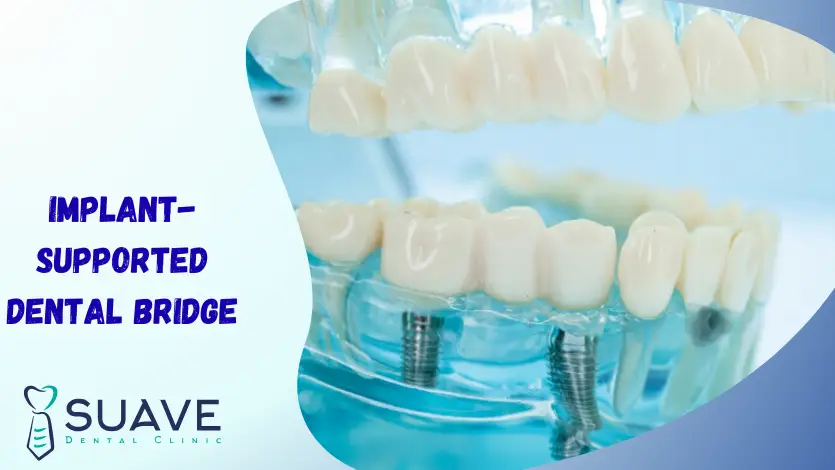
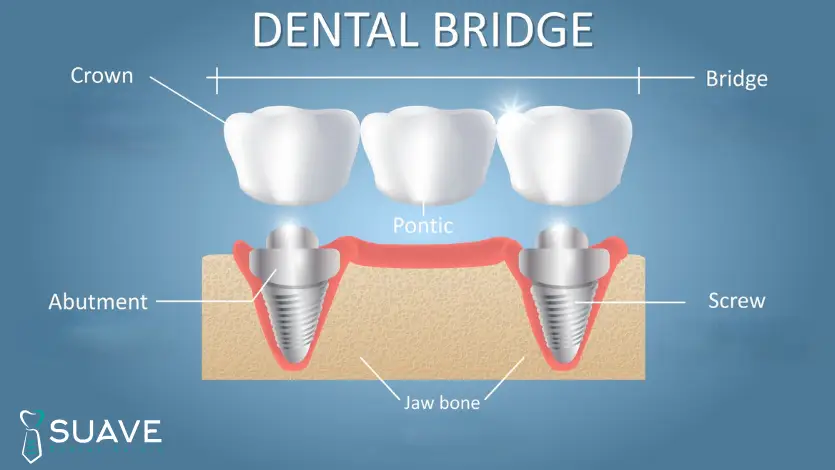
An advanced type of dental bridge designed to replace at least 3 missing teeth or more in one arch quadrant, with the added benefit of using dental implants for support.
Unlike a teeth-supported traditional bridge, this type is secured directly to dental implants, which are surgically placed into the jawbone. After a healing period of 3 to 6 months, the artificial fake teeth (the dental bridge, which consists of multiple connected crowns) are finally placed, providing a more stable and durable replacement for missing teeth. It offers a more natural look with improved chewing ability.
Benefits of Implant-Supported Bridges
An implant-supported bridge has multiple advantages that make it a unique choice:
- Bone preservation
The presence of dental implants on either side of the missing teeth helps maintain jawbone quality and prevent bone resorption, which occurs gradually after tooth loss. This keeps the normal facial contour. - More durable
With proper health care maintenance and regular dental visits, implant-supported bridges are permanent and can last over 15–20+ years. - High stability
Due to strong root-like anchorage from the titanium screw surgically inserted into the jawbone. Providing more stability and preventing slipping. - Neighboring teeth preservation
This option protects the adjacent teeth in two ways. First, it doesn’t require any preparation of neighboring teeth. Helping them stay healthy for a long time.
Second, it prevents the adjacent teeth from drifting into the gap, avoiding any future issues. - Improved aesthetics and comfort
Dental implants provide a more natural feel and look, while the loaded dental bridge matches the color, shape, and size of the remaining natural teeth. With the highly stable implant bridge in its place with no slipping, it allows the patient to smile, talk, and eat comfortably.
How an Implant Bridge Differs From a Traditional Dental Bridge
| Traditional denture | Implant-supported denture | |
| support | Rely on the neighboring teeth to the gap; need to be prepared and crowned for support. | Commonly use 2 implants at each end of the bridge. The Titanium screw of each implant provides support for the bridge. |
| Adjacent teeth condition | Need sound, natural neighboring teeth | It doesn’t matter the condition of the adjacent teeth |
| Number of teeth replaced | Usually, replace one or two missing teeth. | Replace from 3 teeth up to full mouth implants |
| Bone quality and preservation | Doesn’t need high bone quality, although bone resorption occurs with time. | Need healthy bone to fuse well with the surgically inserted implants. Ideal for bone preservation and preventing further bone loss. |
| Treatment duration | Usually takes a few days to get the final replacement | It takes months until the final restoration is completed. |
| Procedure | Only the preparation of adjacent teeth, then making a dental impression, which is sent to the dental lab | Including the surgical placement of dental implant posts, loading the abutments, then a digital impression is taken and sent to the lab. |
| Cost | Less expensive (stats from $1200 for a 3-unit bridge) | More expensive (about 2500 USD or more) |
| durability | Durable (from 5 to 15 years) | More durable (more than 5-10 years) The implants themselves have a longer lifespan, averaging 10-20+ years. |
When do I need Implant Bridges?
Implant-supported bridges are ideal in some cases. Like:
- Multiple missing teeth in the same row
When more than two consecutive teeth are missing in the same row, and you want to replace them with one stable restoration. - Enough bone density
If you have sufficient bone density to support the dental implant titanium screws, that will hold the bridge in place. - The condition of the adjacent teeth to the missing ones
If Adjacent teeth around the gap of missing teeth are weak and severely decayed, and an implant bridge doesn’t depend on these teeth’s support and strength - Healthy adjacent teeth
When the adjacent teeth are healthy, an implant bridge is preferred because a traditional bridge requires cutting down (preparing) the neighboring teeth to act as abutments. The implant bridge preserves the structure of these healthy teeth - Bone preservation
If your priority is to preserve your facial contour and prevent face sagging. This option is the best to maintain your facial support.
Unlike conventional dental implants, implant bridges preserve bone quality and volume by transmitting the chewing forces to the bone, which helps minimize jawbone gradual resorption and shrinkage. - More stability
If you want to invest in your comfort and get a more stable option than a traditional bridge.
See why replacing missing teeth is more urgent than you think!
Types of Implant-Supported Bridges
- Fixed implant-supported bridge
A fixed replacement of multiple teeth next to each other, which can’t be removed by the patient, is made from different durable and aesthetic materials, in the form of a zirconia bridge or a ceramic bridge loaded on two dental implant abutments. - Removable implant-supported bridge
This is referring to an overdenture, which is secured to the jawbone through the attachment of dental implants. It can be removed for cleaning and care maintenance. - Hybrid implant-supported bridge
This option combines a removable and a fixed implant-supported bridge. This gives it the advantages of both and becomes more flexible. It can be used in specific cases to provide flexibility in some areas. - Full Arch Implant Supported Bridge
Full mouth implants are another type of implant-supported bridge, which is designed to restore all missing teeth with a fixed zirconia bridge attached to the abutments of implants in the jaw, or with a high-compact resin denture screwed to the dental implants permanently. - Full mouth reconstruction with Implants has different approaches according to the number of implant screws surgically placed into the jawbone, like all-on-4, all-on-6, and all-on-8 dental implants

full mouth implants types, for more stable, long-lasting full mouth restoration
How Many Teeth Can an Implant Bridge Replace?
Minimal implants for an implant-supported prosthesis are 2 implant screws at each side of the gap:
- To restore 2 missing teeth: one implant can be used to support a bridge of 2 units, which is known as a Cantilever bridge. However, this option carries a high risk of fracture due to uneven force distribution.
Therefore, it’s preferable to use 2 implant posts to support 2 single crowns.
- To restore 3 missing teeth or more in the same row: two implants are fixed on each side of the bridge to replace 3 or more teeth, and in long-span cases, a middle extra implant is needed for even forces distribution and a stronger, more durable restoration.
- To restore a large number of teeth or a full set of teeth, a full arch bridge can replace all missing teeth in one jaw. That is fixed in its place by multiple implants in the jaw.
These implants are strategically distributed through the jaw according to each case. The more missing teeth, the more implants needed for support.
Implant-Supported Bridge Cost in Turkey
Implant implant-supported bridge is more expensive than traditional bridges, as it is a complicated procedure that combines the cost of titanium dental implants and a dental bridge.
The price also depends on the material of the bridge, whether it is made of Emax crowns, Zirconia Crowns, or high-compact acrylic dentures
Average prices of a 3-unit implant-supported ceramic bridge can start from $6000 or more in most European countries.
The average cost in Turkey differs depending on different factors number of implants used and the materials used. The cost average is about $1500.
Implant Bridges Aftercare
The maintenance of any dental treatment is as important as getting high-quality treatment aftercare, helping to maintain the implant bridge for decades without any problem. The main concept is to keep the prosthesis clean and maintain healthy gingiva.

See all the instructions you should follow about dental crowns and bridges aftercare.
First, you should do the usual oral care routine:
- Brushing at least twice daily with fluoridated toothpaste and a soft toothbrush
- Use dental floss in between meals to prevent any plaque or bacterial accumulation
Here are extra steps to take:
- Use a coated interdental brush to keep around artificial teeth and implants clean
- Use water floss to provide excellent oral hygiene without any accumulation in-between fake teeth.
- It is better to avoid sticky or hard food to avoid displacement of the bridge
- Stop smoking, as smoking can increase the failure rate of implants
Get A Free Dental Consultation
Get A Personalized Treatment Plan and Quotation
Implant-supported Bridge FAQs
Can one implant support a bridge?
In theory, one implant can support a two- or three-unit bridge. However, clinically, this is considered a risky approach since it causes food debris and bacterial accumulation on the fitting surface of the pontics, making teeth cleaning difficult, as well as gingival inflammation around the crowns.
It also harms the jawbone because of the uneven chewing force distribution that results from the uneven stability of the dental bridge supported by one implant.
Can I eat normally with a tooth bridge?
Yes, of course, dental bridges are strong and more resistant to chipping and wear, so they improve chewing ability. However, it is preferable to start with soft food until full adjustment, then eat whatever you want.
Is it cheaper to get a bridge or an implant?
Usually, bridges are cheaper than implants, and insurance may cover them. But in the long term, it becomes more costly due to the need for maintenance or possible replacement. So, implants are considered more cost-effective in the long run.
What is the best type of dental bridge?
The best type of dental bridge differs from one case to another. However, an implant-supported bridge is considered the strongest and most durable one.
What are the problems with dental implant bridges?
It isn’t common to have problems with dental implants. But problems such as the whole implant bridge loosening due to implant itself looseness, difficulty in cleaning, or any surgical risks can occur.
Can I eat normally with implant-supported dentures?
Yes, you can eat normally with implant-supported dentures, but after the healing period, osseointegration, better implant stability within the jawbone, and final replacement of screwed dentures, or removable overdentures
Why does a doctor prefer a bridge over an implant?
Dentists may prefer bridges in some cases. where there isn’t enough bone for implant placement, when surgery is contraindicated, or when the adjacent teeth already require crowns. A bridge may also be preferable for patients with a limited budget or when faster treatment is needed.

References
Medically Reviewe