Tooth filling vs crown TOC
If you have a badly decayed tooth and want to fix it. You are often torn between getting a filling or a dental crown.
Both options can restore the tooth properly, but they are used in different cases, depending on the extent of tooth damage, the remaining healthy tooth structure, and the overall tooth condition. Let’s understand the difference between teeth fillings and crowns to help you make an informed decision.
What is a tooth filling?
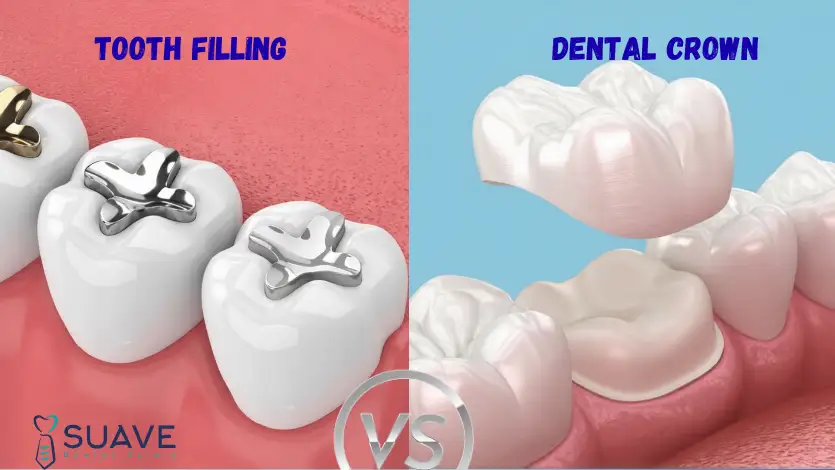
A tooth filling is a dental procedure used to fix various tooth defects, such as cavities caused by tooth caries, minor cracks, and chips, by filling or reshaping the affected areas to return the tooth to its normal condition.
It’s just a patch of a dental filling material that fills a cavity or a hole in the tooth structure, like composite bonding, to restore the shape and function of the healthy, sound tooth with minimal intervention.
What is a dental crown?
A dental crown is an artificial tooth cap used to cover the whole surface of a damaged or broken tooth, for tooth protection and strengthening.
It’s a permanent tooth restoration that provides superior hardness and tolerates masticatory forces with much more strength and durability than a tooth filling.
Comparing Crowns and Fillings
| Teeth Filling | Teeth Caps (Crowns) | |
| Benefits | Restore aesthetic Restore function, “chewing ability.” Limited life span, can stay intact and functional up to 5-7 years. It may need further replacement after several years. | Improve aesthetic Enhance chewing ability Fix decayed, broken, and worn teeth Protect teeth from wear Long-lasting solution up to 10-15 years with proper care. |
| Material | Direct restoration Amalgam Glass ionomer Composite bonding Indirect restoration Indirect composite inlays and onlays Ceramic inlays and onlays. | Metal crown PFM ”porcelain fused to metal.” Ceramic Crowns like: Zirconia Crowns, PFZ “porcelain fused to zirconia” “Layered Zirconia Crowns.” Emax Crowns Temporary resin crown Same-day crown, “Cerec crown.” |
| Cost | 150: 300 USD per tooth | 400:1500 USD per tooth |
Common Reasons Why You May Need a Dental Crown Instead of a Filling
Although both fillings and crowns can restore a decayed tooth, a dental crown is preferred in certain cases where fillings alone are no longer sufficient. These include:
- Insufficient remaining tooth structure:
Teeth with large cavities, old extensive fillings, or multiple affected surfaces often become too weak to be restored with a filling alone. So, it’s difficult for a tooth filling to effectively restore the tooth structure. - An endodontically treated tooth
A Tooth after root canal treatment becomes more brittle and more liable to fracture. So crowns provide superior protection of the remaining tooth structure. - Teeth with large defects
While filling can restore minor chipping or fracture, if extended further, filling will be unsuitable anymore. Teeth with extensive cracks, large fractures, erosion, and excessive wear can be repaired with a dental crown - Aesthetic priority
The crown can improve the shape, color, and alignment. Through perfectly masking any teeth discoloration and stains, filling the minor space between teeth, and at the same time offering high stain resistance, this blends seamlessly with the neighbouring teeth. - Strength and Durability
Since a crown is made from high-strength materials like zirconia and ceramics, it offers more strength than traditional fillings and also remains functional for decades with proper oral healthcare. - As a part of a prosthesis
Crowns are placed on top of dental implants as one of the best tooth replacement options, it also used to restore missing teeth by filling the gap as pontics in a dental bridge prosthesis.
How to take the final decision?
Consulting experts always benefits you in making good decisions. At Suave Clinic, we offer a free consultation with one of our experts.
You will go in an online meeting with one of our dental team members to express your concerns and discuss dental restorative options that meet your expectations.
Our consultant will guide you through the prerequisites of the dental assessment, like your detailed medical history, the symptoms you feel, photographs, and x-rays, to decide what’s more suitable for your needs and your expectations.
Based on your oral and dental condition, you will be guided towards restorative dental treatment with superior results.
After arriving in Istanbul, a further professional clinical examination is done, and you will understand your case, your needs, the priority of each treatment, and which one is better for you.
Choosing which is better filling or a crown, depends on your own tooth condition. Each option offers unique benefits. If you notice decay or damage, seeking early treatment with our professional dentists at Suave Clinic helps you preserve your healthy tooth and ensures long-term results.
Get A Free Dental Consultation
Get A Personalized Treatment Plan and Quotation
Tooth Filling vs. Crown FAQs
Is it better to get a filling or a crown?
There are no one-size-fits-all cases. While a filling works better in some cases, like minor defects and pits, and fissure tooth caries, a crown is the best for extensive carious lesions and a tooth with pulp therapy. The best choice depends on each case.
Can I ask for a filling instead of a crown?
Of course, you can ask for a filling instead of a crown. However, the final decision should be based on the dentist’s assessment of your case and the best option for you specifically.
Are fillings safe during pregnancy?
Yes, fillings are safe during pregnancy and are usually recommended during the 2nd trimester.
What is the downside of crowns on teeth?
Some common downsides of a crown may occur, including: mild temporary discomfort eases with time, poorly fitted margins may lead to decay of the underlying tooth, and being more expensive than other conservative treatments.
Is crowning a tooth a good idea?
Crowning a tooth is a practical solution to repair badly decayed teeth and restore their function, protect tooth structure from further decay, and save tooth appearance and function from dental extraction.
When can a tooth not be crowned?
A tooth is not recommended for a dental crown when the tooth’s root itself becomes damaged from extensive decay, internal resorption, or severe cracks, or when the gingiva that surrounds the tooth is badly infected and lacerative.
Otherwise, weak teeth with infected pulp could be perfectly treated with pulp therapy, reinforced by post and core build-up restoration, and then protected by a dental crown

References
Medically Reviewe