Table of Contents
Teeth gaps are so frequent; gaps between children’s teeth (primary teeth) are a sign of healthy development of permanent teeth, while in adults, it may be healthy, but not aesthetically acceptable.
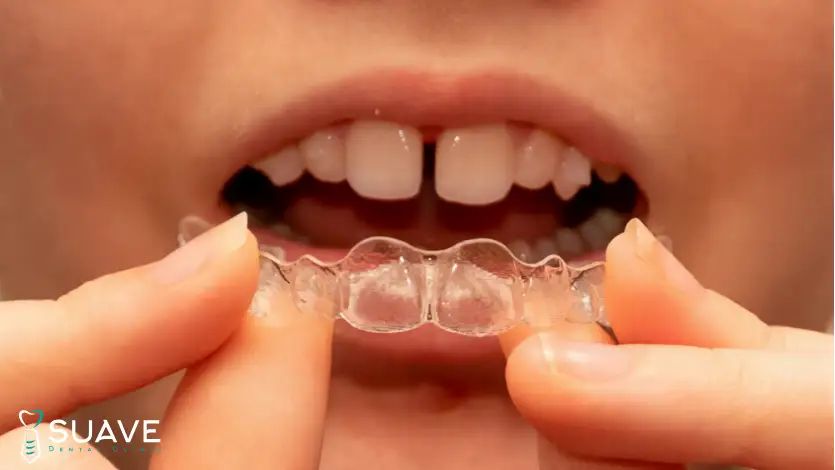
If you feel uncomfortable with your gapped smile, let’s boost your confidence and close these spaces with Invisalign for teeth gaps.
What Causes Gaps Between Teeth?
The presence of gaps between teeth may not be as pretty a sign as it used to be centuries ago. Gaps between the two front upper teeth (two upper centrals) are the most prevalent and are called Diastema, which is considered an aesthetic dental issue.

Dental gaps generally may indicate an underlying issue, like:
- The presence of buried extra teeth inside the jawbone pushes the teeth apart (Supernumerary teeth, such as a Mesiodens).
- A thick labial frenum with high attachment to the gingiva between the two upper or lower front teeth (the tissue between your lips and teeth) that pulls the front teeth apart and causes diastama.
- Periodontal (gum) disease
- Teeth shifting into the place of missing teeth
Teeth gaps may be a result of childhood bad habits, like:
- Thumb sucking, or active pacifier sucking, after weaning age, which causes pacifier teeth.
- Tongue thrusting while mouth breathing or thumb sucking, the tongue pushes against teeth during swallowing or speech, and it can gradually open gaps.
- Buck teeth are caused by a severe open bite, which causes flaring of teeth and the formation of gaps.
Gaps resulting from genetic causes:
- Bone morphology: Disproportionate Jaw and Tooth Size, teeth are small in a wide jaw, leaving gaps between them.
- Small individual tooth anomalies, peg-shaped laterals which are common.
Complications of Neglected Gapped Teeth
Untreated teeth gaps can lead to functional and biological problems, such as the following:
- Less self-confidence while smiling and talking.
- Food impaction and gingival pockets.
- Plaque retention
- High risk of gingival inflammation, gingival bleeding, and periodontitis
- Chewing becomes less comfortable
- Uneven biting forces on the gingiva and underlying bone lead to bone resorption acceleration and gingival laceration.
- Speech alterations, such as slight lisping
Early diagnosis and treatment planning reduce the chance of gum problems and simplify the orthodontic treatment needed to close spaces.
Invisalign For Teeth Gap Treatment
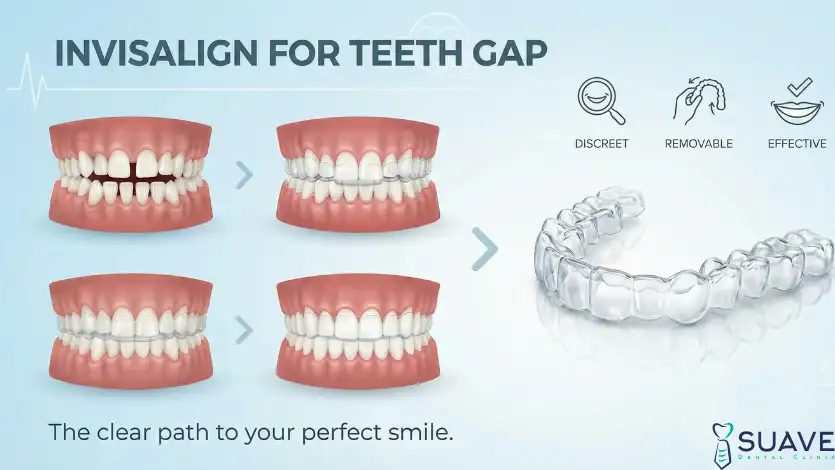
Invisalign (clear aligner therapy) is a highly predictable solution for many spacing problems, including mild to moderate teeth gaps and more complex spacing patterns.
Modern clear aligner systems use a sequence of digitally designed clear, comfortable aligners to shift the entire tooth into its correct position gradually.
Clear aligners apply gentle pressure that moves the teeth safely; they are also easy to clean, and teeth and gingiva are easily brushed while maintaining good oral hygiene.
Invisalign is preferred by both practitioners and patients for its convenience, comfort, and to keep your gums healthy, too.

See the difference between Invisalign vs. braces, and which is better for your perfect teeth alignment.
Using 3D digital planning gives a preview of the whole movement plan and allows clinicians to select the right Invisalign service packages (Lite, Moderate, Comprehensive) or advanced layer plan (14 / 24 / Infinite layers), all are available at Suave Dental Clinic to match treatment complexity at affordable prices.
Invisalign must be worn all day, including during sleep, for 20–22 hours daily; Wearing aligners for fewer hours slows progress, so the main drawback is that it relies on the patient’s competence.
How Does Invisalign Close Gaps Between Teeth?
Invisalign closes teeth gaps by using a series of custom-made, clear aligners that gently guide your teeth into their ideal positions. Each set of aligners is designed to make a small, controlled force application. Each set is designed to apply continuous pressure on the specified teeth, bringing them closer together.
- Invialign Fabrication
- Custom-designed aligners: Suave’s treatment starts with digital scans of your teeth with an intraoral scanner. These scans are used to take precise shots and measurements of each tooth dimension and gingival lines.
- These scans are implemented into software for digital smile design workflows, where our cosmetic experts and orthodontists manage to design the first clear aligner set that moves teeth in specific physical movement.
- The digital Invisalign design is sent to a CAD/CAM device to mill and make it of multilayer thermoplastic sheets.
- Then, clear aligners are received and put into the patient’s mouth to wear.
- Gentle pressure to move teeth
Every new aligner is shaped slightly differently. When you put it on, it applies gentle pressure that stimulates your teeth toward closing the gaps. You may feel mild tightness for the first 1–3 days; this is normal and proves that the aligner is working. - Small steps movement
Each aligner moves the teeth a tiny amount. When you switch to the next set, your teeth continue moving closer together until the gaps are fully closed. - Invisalign paired with other treatments
In some cases, Invisalign may be paired with small attachments or elastics to guide difficult movements or improve the bite of certain complex cases.
Also, in case of gaps that are caused by a thick labial frenum, combined approaches (frenectomy + orthodontic closure) may accelerate and stabilize results. - Digital monitoring for perfect results
Your orthodontist regularly reviews your progress and adjusts the plan if needed to ensure your gaps close smoothly and stay closed.
This is why Suave Dental Clinic’s multi-layer packages (14, 24, Infinite) are useful to manage all complex cases.
How Much Does Invisalign Cost To Close Teeth Gaps?
Invisalign cost depends on case complexity, the number of aligners needed, and the treatment plan selected.
When comparing costs, consider treatment time, number of clinic visits, and the likelihood of needing additional refinements. Because Invisalign is fully digital, your visits are fewer and faster.
Most patients pay between approximately $4,000–$8,000 USD in many markets, with lower costs for simple gap-only treatments and higher costs for comprehensive corrections or where refinement aligners and auxiliaries are needed.
Suave Dental Clinic’s transparent packages (Lite, Moderate, Comprehensive; plus 14/24/Infinite Layers) are priced by the complexity and number of visits; each package includes consultation and panoramic X-ray.
By simple online consultation, you can receive a full, detailed personalized quote.
How long does Invisalign take for gaps in teeth?
The treatment duration for closing gaps varies based on gap size, bone response, gum health, and patient compliance.
Patients typically change aligners every 1–2 weeks, depending on the orthodontist’s instructions. Good oral hygiene and wearing aligners for the recommended hours directly shorten the overall treatment time.
Luckily, you can start seeing changes as early as 6–12 weeks.
But we can say that on average, small gaps (1-2 mm) can close in approximately 3 to 6 months, while more significant gaps (4-5 mm) may take 12 to 18 months to close.
Regular follow-ups and Commitment to consistent wearing as instructed are the key factors to assess the length of the treatment plan of Invisalign and predict its success.
Watch out: Wearing a retainer after treatment is essential to prevent gaps from reopening.
Daily patient care routine with Invisalign
Because aligners are removable, they make daily oral hygiene simpler than fixed braces.
Clear aligners can help maintain gum health when patients follow hygiene protocols:
- Brush after meals and before reinserting aligners
- Floss daily
- clean aligners regularly, by brushing the fitting surface with a small soft brush.
Most orthodontists recommend brushing after every meal (or at least twice daily, plus brushing before reinserting the aligner) to minimize plaque buildup beneath the aligner.
This keeps the aligners clear and reduces the risk of white spots and gingivitis.
Comparative approaches to close the gap in teeth
Actually, there are several clinical pathways to close a gap:
- Orthodontic movement ( braces and wires): They physically move the whole tooth.
- Restorative approaches (composite bonding or veneers by reshaping the tooth to close the gaps): This is suitable only for very small spaces, but it does not change the teeth’s actual position.
- Implants/bridges for spaces caused by missing teeth
- Combined therapy (frenectomy + orthodontics): Some cases need a small gum procedure before closing the gap.
Orthodontic treatment (Invisalign or braces) offers the best long-term value, as it provides the most stable and natural-looking results.
In many cases, your orthodontist will determine if aligners or braces are the best option based on gap size, gum health, and overall bite alignment.
Your Confidence starts with a Perfectly Aligned Smile
With Invisalign for gapped teeth, you don’t have to choose between comfort and aesthetics.
But remember that proper case selection, patient compliance, and good oral hygiene are all important in the success of the treatment.
At Suave Dental Clinic, we combine advanced 3D digital scanning, personalized Invisalign planning, and VIP patient care to ensure predictable and comfortable treatment results. We use Invisalign clear aligners, the most advanced, nearly invisible solution, to gently move your teeth into perfect alignment without wires or brackets.
Our expert team is ready to guide you every step of the way, from your first consultation to your final aligner.
Your smile deserves to look and feel its best, so book your online consultation with us today.
Get A Free Dental Consultation
Get A Personalized Treatment Plan and Quotation
Invisalign for Teeth Gaps FAQs
Is Invisalign painful?
Invisalign is not typically painful, but it can cause some mild pressure for a couple of days after changing your aligner, which is a normal sign that the treatment is working.
At what age is best for Invisalign?
Kids as young as 6 and adults age 50 and over, as long as you decide to transform your teeth and rehabilitate your smile, Invisalign is perfect for you.
Do you sleep with Invisalign?
Yes, you must sleep with Invisalign aligners, because treatment requires them to be worn for 20 to 22 hours per day, which includes nighttime.
How many times do you brush your teeth with Invisalign?
You should brush your teeth with Invisalign at least twice a day (after your first meal and at night). Moreover, it’s better to brush your teeth regularly after each meal.

References
Medically Reviewe