Table of Contents
Enamel is the most mineralized tissue in the whole body, protecting the inner sensitive layers (dentin and pulp). Although it is hard enough, it can be suddenly fractured without warning when exposed to trauma or even when you are chewing your favorite food.
It is not only the discomfort feeling after your tooth has broken, but it also affects your smile, confidence, and even your overall mouth health.
But the good news is that there are many options Suave clinic offers to fix your broken tooth, and we will mention them in this article.
How Do You Know You’ve Broken a Tooth?
Cracked or broken teeth may not always have symptoms and vary from one to another; however, you can feel some of the following signs:
- Sensitivity to hot or cold drinks and food.
- Mild to severe pain on biting or chewing.
- A noticeable fracture or an absent tooth part.
- Sometimes swelling around the teeth.
See all the reasons why your teeth hurt when you bite down?!
Types of Tooth Breaks
Tooth cracks vary widely in type, severity, and symptoms. These often happen from trauma, chewing on hard things, or extreme temperature differences. Understanding the overall properties of these fractures is important to enable accurate diagnoses and effective selection of treatment strategies.
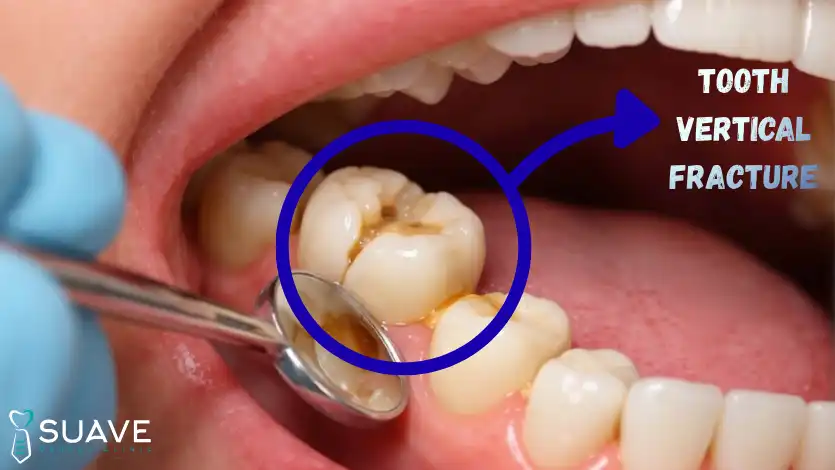
5 types of vertical fracture
- Craze Lines (hairline cracks)
Craze lines are tiny vertical cracks that only affect the enamel. They are symptomless and usually do not require treatment, except for cosmetic reasons. - Fractured Cusps
A fractured cusp is when part of the tooth’s crown breaks off, and usually this happens either completely or partially, especially when teeth are clenching and grinding.
The enamel layer is ground, and the damage extends to the superficial dentin layer, which is why patients may start feeling tooth pain and sensitivity or pain on biting over time. - Cracked Tooth
A cracked tooth is an incomplete fracture that starts at the crown and extends below the gum line. This type of fracture is considered a serious dental issue where the fracture extends deep in the dentin layer, affecting the pulp tissue, causing pain on hot, cold, biting, chewing, and also spontaneous pain. - Vertical Root Fracture
Vertical root fractures are symptomless and start at the root and move upwards. They are often linked to previously treated root canals and are difficult to detect and treat.
With regular check-ups, dentists can discover root fractures earlier and they can be treated with proper root canal treatment; however, this hidden fracture can cause gingival swelling and tooth infection if detected later. - Split Tooth
A split tooth is a crack that goes all the way through the tooth, splitting it into two separate sections. This type of fracture usually occurs from the long-term effects of an untreated cracked tooth, or by harming the tooth with bad habits like opening cans and bottles, biting on hard objects, or cracking nuts with teeth.
The tooth structure is more damaged, and the patient may experience unbearable pain that needs instant dental intervention.
Teeth chipping
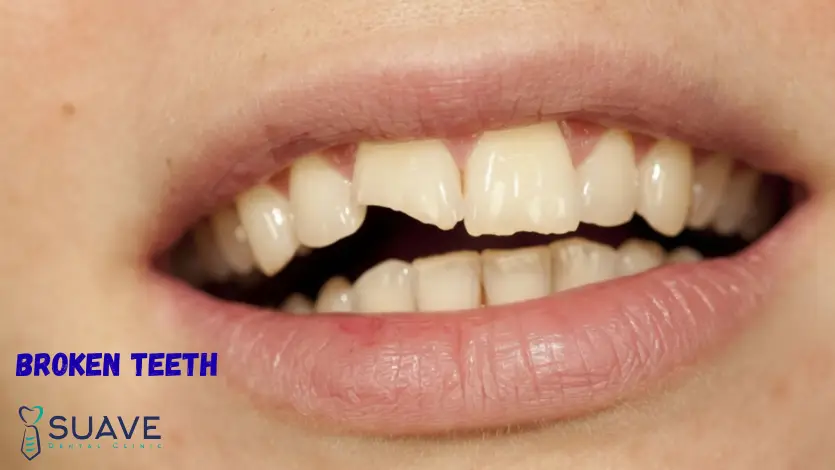
Bad habits, trauma, or underlying tooth caries can cause a horizontal fracture in a tooth’s crown. It’s also more noticeable, and early detection can save the tooth.
These tooth breaks, like teeth chipping, could be superficial, where only the enamel layer is broken off in a horizontal line. This superficial enamel chipping is symptomless, but causes some aesthetic concerns.
Broken tooth’s crown
When a piece of the tooth’s crown is broken off, leaving a hollow or space in your smile. This can be due to tooth caries, decay, trauma, a blow to the face, or an old filling dislodgment.
This may be accompanied by sharp pain, swelling, and tooth movement, and needs a dental visit and consultation as soon as possible.
When is a Broken tooth Unsalvageable?
If a tooth is either chipped or broken while the root ( the part of the tooth in the bone) remains intact, your dentist might restore it using a tooth-colored filling, crown, dental veneer, Conversely, if the damage extends into the pulp (the nerve center of the tooth), a root canal procedure may be required to eliminate the infected tissue, after which a crown will be placed to restore functionality.
In more severe cases, where the fracture extends beneath the gumline, the tooth may become beyond repair. A broken root or a tooth that is divided into two parts typically necessitates extraction and tooth replacement.
How do dentists restore broken teeth?
(Broken Teeth Treatments)
Restoring the broken teeth depends on the severity of the damage, the dentist’s evaluation, and the treatment plan. Below are the most common options:
- Dental veneers
In case of superficial enamel wear, chipping, or craze lines, Emax veneers and ceramics like zirconia veneers are the best for masking any imperfections and protecting the tooth structure. - Dental bonding
Composite bonding restoration, as a tooth-colored dental filling, is used to rebuild the broken part, like in class III and IV, to complete the fractured part of the tooth and restore the patient’s smile. - Dental crown
Ceramic crowns, inlays, and onlays are used in cases that need full coverage of the remaining tooth by a cap to restore its shape and function. It has different types, which look like natural teeth, like Emax, Empress, and Zirconia crowns. - Root canal treatment
If the broken tooth part is large enough to expose the pulp tissue (the inner soft tissue that contains nerves and blood vessels) or there is pain or a change in tooth color, the dentist will remove it and put a special filling to avoid infection, then put a crown over it.
If a tooth is broken at the gum line but the root is healthy, then a dental post (pin) is inserted into the root canal to support the crown.
What to Do if You Break or Chip a Tooth?
You have to see your dentist as soon as possible if you have a broken tooth to avoid further damage and to promote healing. The following are care steps after having a chipped or fractured tooth:
- Have an emergency dental appointment.
- Rinse your mouth with warm salt water or saline to remove any bleeding or debris.
- If there is pain, try to have over-the-counter pain analgesics.
- If there is a sharp edge, cover it with a piece of wax, paraffin, or sugar-free chewing gum to prevent it from cutting your tongue or the interior of your lip or cheek.
- Save the broken part in milk or saliva if available; the dentist may try to reattach it.
- Eat soft food, avoid spicy or citrus foods to reduce the pressure on the affected tooth and prevent further irritation.
- Gentle brushing and flossing teeth to maintain healthy teeth and gums.
Complications of ignoring tooth fractures and breaks
Broken teeth may lead to several complications if left untreated, which include the following:
- Inflammation and infection
When a tooth fractures, the protective enamel can become compromised, permitting bacteria to access the inner pulp of the tooth. This may result in inflammation and infection within the tooth, extending to the root and the surrounding tissue, periodontitis, causing severe pain, and then progressing into a dead tooth if neglected. - Dental Abscess and Face Swelling
One of the most common complications is a tooth abscess, a collection of pus resulting from a bacterial infection surrounding the root of the tooth, that can infect the facial spaces, causing serious swelling that requires emergent surgical intervention. - Teeth extraction
When the damage or infection is extensive, and the tooth cannot be salvaged, extraction may be the final solution, and then the patient can replace the extracted tooth with a dental implant or a dental bridge.
The longer a fractured tooth root remains untreated, the more complex the treatment process becomes. Book your free consultation at Suava Clinic and take the initial journey towards a more radiant and healthier smile.
Get A Free Dental Consultation
Get A Personalized Treatment Plan and Quotation

References
Medically Reviewe